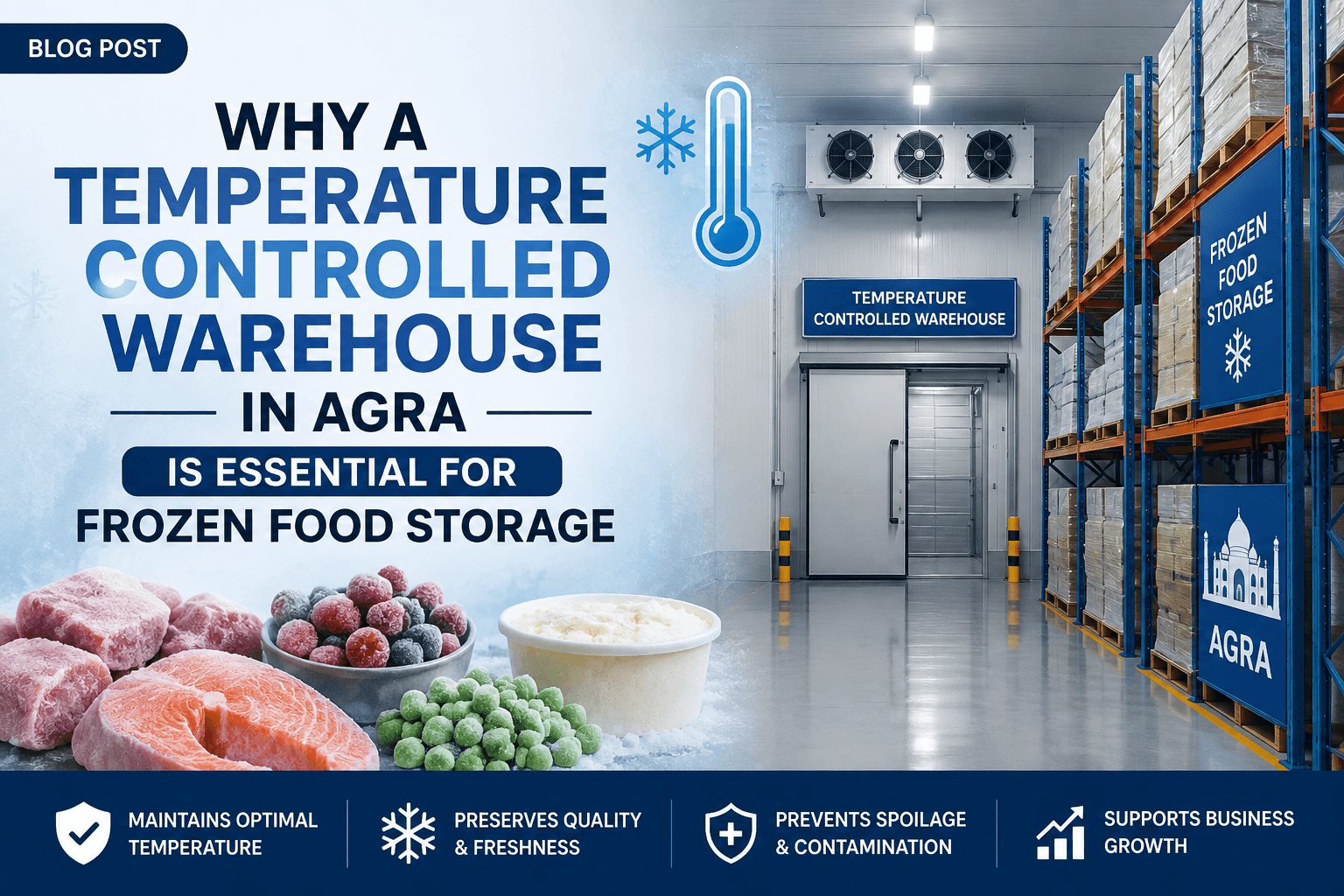
Frozen food is one of the least forgiving categories in the entire cold chain. Ice cream, processed foods, frozen snacks, and ready-to-cook products don’t just need to be kept cold — they need to stay deep-frozen, without a single meaningful lapse, from the moment they arrive to the moment they’re dispatched. In a market like Agra, where power interruptions are a fact of life, that makes a properly run temperature controlled warehouse in Agra not a nice-to-have, but a necessity.
The problem with treating all cold storage the same
Agra is packed with cold stores, but the vast majority were built for one job: holding potatoes at a single temperature through the season. That model works for a hardy root crop. It does not work for frozen food.
Frozen products sit at sub-zero temperatures, and even a brief thaw-and-refreeze cycle can ruin texture, taste, and safety. A warehouse in Agra that isn’t purpose-built for deep-freeze storage — with the right refrigeration, insulation, and backup systems — puts every frozen consignment at risk. For frozen food suppliers, FMCG companies, and distributors, that risk translates directly into rejected stock, complaints, and lost customers.
What “temperature controlled” should actually mean
The phrase gets used loosely, so it’s worth being clear. A genuine temperature controlled warehouse in Agra delivers:
- Dedicated deep-freeze chambers that hold stable sub-zero temperatures, kept separate from chilled and ambient storage.
- 24×7 temperature monitoring, with real-time tracking so any drift is caught immediately rather than discovered after damage is done.
- 100% power backup, so cooling never stops when the grid does — the single most important safeguard for frozen goods in this region.
- A hygienic, certified environment that meets the standards food products demand.
At Raw Freeze, frozen food storage is handled in dedicated chambers designed for exactly these conditions, with continuous monitoring and reliable backup power keeping the cold chain unbroken.
What happens when the cold chain slips
It helps to understand why frozen food is so unforgiving. When a frozen product partially thaws and then refreezes, the water inside it forms larger ice crystals that break down cell structure. The result is mushy texture, separated sauces, freezer burn, and — most seriously — conditions where bacteria can grow. None of this is always visible on the surface, which is exactly what makes it dangerous: the product may look fine and still be compromised. That’s why a facility built to hold a steady sub-zero setpoint, with backup power ready the instant the grid fails, matters far more for frozen goods than for hardier chilled produce.
Frozen food storage in Agra: who needs it
Demand for frozen food storage in Agra is rising as the city’s food economy grows. The businesses that depend on it include:
- Frozen food suppliers and manufacturers holding finished stock before distribution.
- Ice cream brands and dairy businesses, whose products are especially sensitive to temperature swings.
- FMCG and processed-food companies managing regional inventory.
- Hotels, restaurants, and retail chains that need a dependable buffer of frozen ingredients.
Each of these relies on the cold chain staying intact at every step. A single weak link — a warehouse that lets temperature drift during a power cut — can undo the care taken everywhere else.
The cold chain is only as strong as its weakest link
Cold chain logistics is a relay. Produce is chilled or frozen at source, moved in refrigerated transport, and held in storage before it reaches the consumer. Storage is where products spend the most time, so it’s where the greatest risk sits. A reliable temperature controlled warehouse acts as the anchor of the whole chain, giving suppliers a safe place to hold stock and manage demand without gambling on quality.
For frozen food specifically, this reliability isn’t just about avoiding spoilage. It protects your brand. Customers who receive a perfectly frozen product come back; those who receive a thawed, refrozen one don’t.
Why businesses across Agra choose a modern facility
The advantage of a purpose-built warehouse comes down to peace of mind. Instead of hoping the power holds and the temperature stays put, you get a facility engineered so it does — backed by monitoring, backup systems, secure premises with CCTV, and a professional handling team that manages loading and dispatch with care.
Raw Freeze offers this at UPSIDA Site-C, Sikandra, Agra — a location easily reached from across the city and nearby districts. For frozen food businesses that can’t afford losses, a modern temperature controlled warehouse turns storage from a worry into a reliable part of the operation.