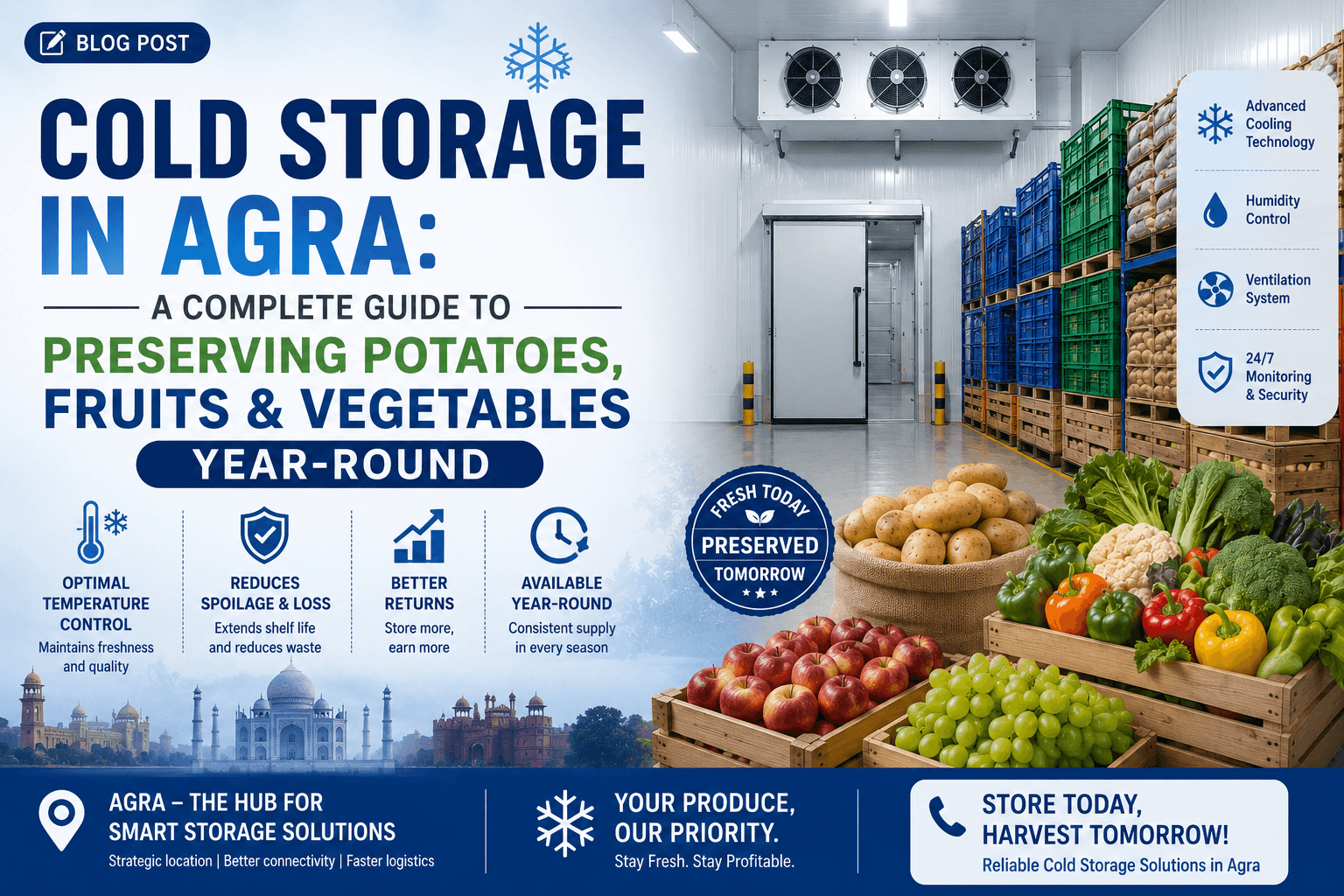
Agra sits at the heart of Uttar Pradesh’s potato belt. In fact, the district holds one of the largest concentrations of cold stores anywhere in India — hundreds of facilities that fill up every February and March as the potato harvest floods in. For farmers and traders here, cold storage isn’t a luxury. It’s the difference between selling at a fair price and dumping crop on the roadside when the market crashes.
But the Agra of today needs more than the old-style, single-commodity potato godown. Fruit growers, vegetable wholesalers, food processors, exporters, and retailers all need reliable, temperature-controlled space they can trust throughout the year. This guide walks through what modern cold storage in Agra should offer, and how to choose the right facility for your produce.
Potato cold storage in Agra: still the backbone
Potatoes remain the region’s biggest crop, and potato cold storage in Agra follows a well-known rhythm. Fresh potatoes are loaded soon after harvest, held at a controlled low temperature to slow sprouting and weight loss, and drawn out through the year as demand rises.
The problem every grower knows too well: at harvest, everyone sells at once, prices collapse, and storage space runs short. A well-run cold store lets you hold your stock, avoid distress selling, and release it when mandis pay better. What matters is consistency — steady temperature, continuous monitoring, and dependable power backup so a few hours of load-shedding never turns into spoiled stock. At Raw Freeze, dedicated chambers and 24×7 temperature tracking are built around exactly this need.
Fruit cold storage in Agra: protecting a delicate crop
Fruit is far less forgiving than potato. Apples, mangoes, grapes, and pomegranates each need their own balance of temperature and humidity, and even a short lapse can cost you an entire consignment. That’s why fruit cold storage in Agra demands precise, well-managed chambers rather than one-size-fits-all bulk space.
Good fruit storage extends shelf life by days or weeks, keeps produce firm and market-ready, and preserves the nutritional value that buyers pay for. For traders supplying hotels, retail chains, and exporters, this reliability directly protects margins. A multi-commodity facility that can hold fruit alongside other perishables — under proper handling and hygiene — gives fruit sellers flexibility that traditional potato-only stores simply can’t.
Vegetable cold storage in Agra: beyond just potatoes
Onions, garlic, green peas, and tomatoes all benefit from controlled storage, yet they’re often overlooked in a potato-dominated region. Vegetable cold storage in Agra helps wholesalers and farmers smooth out the sharp price swings these crops are prone to. Store when supply is high and cheap; sell when the market tightens.
Temperature control slows the enzymatic activity that causes wilting and rot, so vegetables reach the buyer looking fresh rather than tired. For businesses juggling several vegetable lines at once, a facility offering flexible, multi-commodity space under one roof removes the headache of finding separate storage for each crop.
What to look for in a cold storage partner
Not every facility is equal. When you evaluate cold storage in Agra, weigh these essentials:
- Continuous temperature monitoring — 24×7 tracking, not occasional checks, so conditions stay consistent across every chamber.
- 100% power backup — uninterrupted cooling through the power cuts common across UP.
- Hygiene and security — a clean, certified environment with CCTV surveillance and controlled access.
- Professional handling — trained teams for careful loading, organized inventory, and timely dispatch.
- Flexible capacity — plans that suit your volume and storage duration, whether you’re an individual farmer or a large processor.
Year-round storage in a seasonal market
The biggest shift Agra’s food economy is going through is the move away from purely seasonal, single-crop storage. Traditional stores load once and sit idle for months. A modern, multi-commodity facility works all year — chilling dairy, holding fruit through its short window, and keeping frozen goods deep-frozen while potatoes occupy their own chambers. For a trader dealing in several commodities, that means one trusted partner instead of chasing space across the district every season, and steadier cash flow because you’re never fully at the mercy of one harvest.
Why it matters for the Agra region
Cold storage is a critical link in the food supply chain, not just a cold room. It reduces post-harvest losses, keeps produce fresh, extends shelf life, and lets businesses time the market instead of being forced into a glut sale. For a region that grows and trades as much perishable produce as Agra does, that’s real money saved and earned.
Raw Freeze brings modern refrigeration, multi-commodity chambers, and a professional handling team to UPSIDA Site-C, Sikandra — easily accessible from Agra city and the surrounding districts. Whether you’re storing potatoes, fruit, or vegetables, the goal is simple: your produce leaves in the same condition it came in.